
How to Build Your Own Author Marketing System
At some point, marketing starts feeling like a second job.
You finish the book.
Then someone tells you to post on Instagram.
- Then Threads.
- Then Facebook.
- Then TikTok.
- Then start a newsletter.
- Then build a website.
- Then run ads.
Then somehow you’re supposed to do all of that consistently while writing the next book.
That’s usually the point where people start asking:
“What am I actually supposed to be doing?”
I think the answer is simpler than it looks.
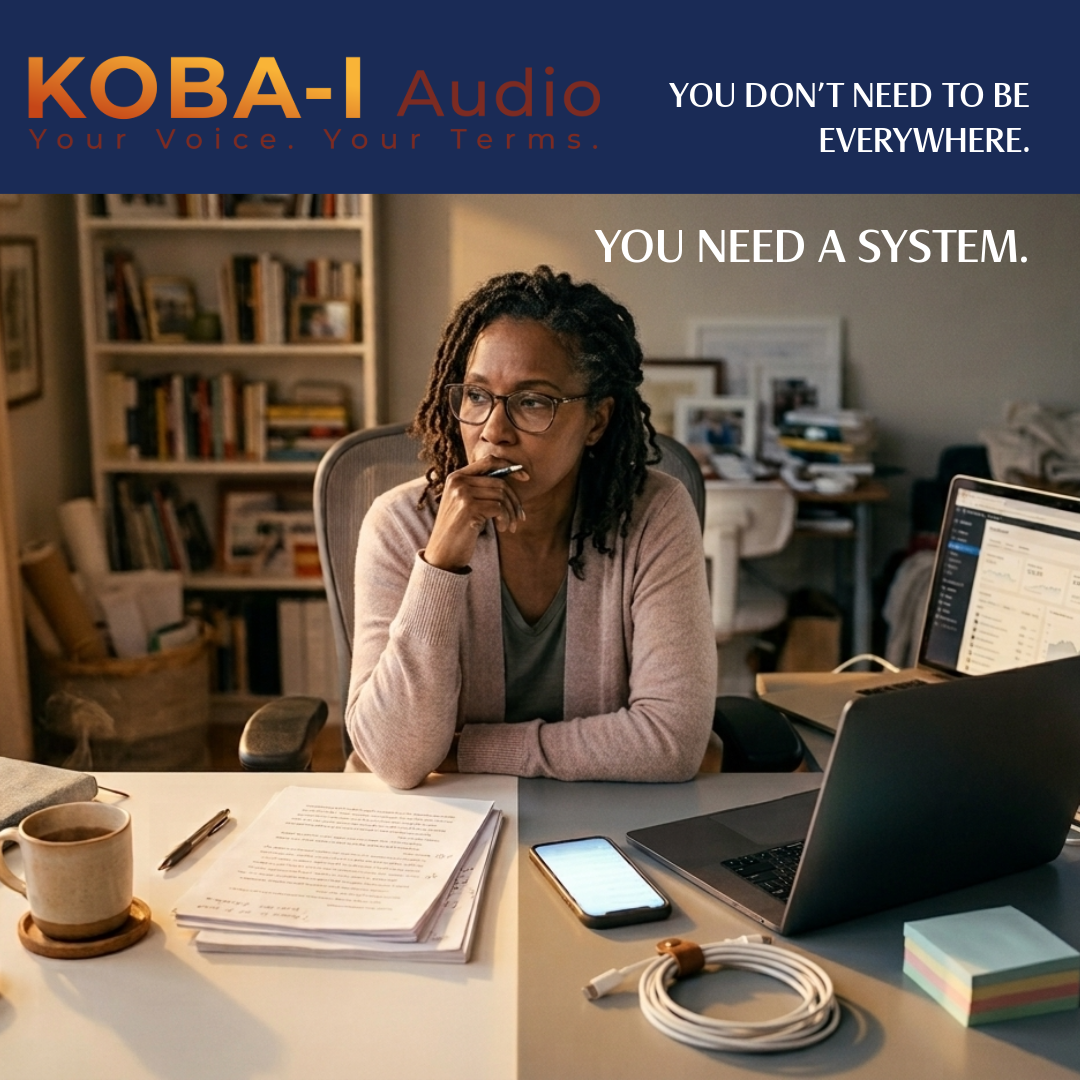
You do not need to be everywhere.
You need a system.
Not a giant marketing machine.
Just a few connected pieces that help someone discover you, understand what you write, stay connected with you, and eventually buy something if they want to.
That is what I mean by an author marketing system.
The Short Answer
An author marketing system is a connected set of tools and habits that help readers move from discovery to relationship.
Someone finds you.
They visit your website.
They learn what you write.
Maybe they join your email list.
Maybe they buy a book.
Maybe they come back later.
The goal is not to force everyone into a funnel.
The goal is to make sure that when someone is interested in your work, there is somewhere useful for that interest to go.
And you can build that yourself.
You do not need KOBA-I Audio to do it.
Start With the Problem, Not the Tools
This is where authors get overwhelmed.
They start asking:
Which email platform should I use?
Which website builder?
Which social network?
Which store?
Those are useful questions.
But they come second.
The first question is:
What do I want someone to do after they discover me?
Read a sample?
Buy the book?
Join your email list?
Listen to an interview?
Explore your Story World?
Book you for a speaking engagement?
Once you know that, the technology gets much easier to choose.
Build an Author Website Readers Can Use
- Give People Somewhere to Land
You need a digital home.
Usually, that means your website.
Not because every author needs some massive custom platform.
Because you need one place where somebody can understand:
- Who are you?
- What do you write?
- What should I read first?
- What can I do next?
That’s it.
Your website does not need to impress another web developer.
It needs to make sense to a reader.
Make Buying and Delivery Easy
And if your current website is basically an About page plus six buttons that send people somewhere else, it might be worth asking:
What is this site actually doing for me?
- Give Interested Readers a Way to Stay Connected
This is where email becomes useful.
Not because email is magical.
Because it gives someone a direct way to hear from you again without depending entirely on whether an algorithm decides to show them your next post.
Give people a reason to subscribe.
Maybe that is:
- a sample chapter;
- a short story;
- a character interview;
- behind-the-scenes material;
- early access;
- a useful resource connected to your nonfiction topic.
And keep one distinction clear:
A customer is not automatically a newsletter subscriber.
Someone buying your book does not mean they agreed to receive ongoing marketing.
That relationship still needs permission.
- Make Buying and Delivery Easy
If direct sales fit your business, you can add a storefront.
That might mean ebooks.
Audiobooks.
Bundles.
Courses.
Signed books.
Whatever makes sense for your work.
But the important part is not “sell direct at all costs.”
It is:
If someone wants to buy from you directly, can they do it without friction?
And after they buy, can they actually get what they paid for without you manually emailing files at midnight?
That is where commerce and delivery systems become useful.
The system should handle the predictable part.
You should not have to sit there waiting for every order.
Connecting the Pieces
Here is the simplest version:
Someone discovers you on Instagram.
They click through to your website.
They read about your book.
They decide they want to hear from you again, so they join your email list.
A month later, you release something new.
They get an email.
They come back.
Maybe they buy.
Maybe they do not.
But now the relationship does not disappear just because the original social post stopped getting views.
That is the point.
Not control over people.
Continuity.
You Can Build This Yourself
You absolutely can.
You can choose your own website platform.
Your own email service.
Your own commerce tools.
Your own delivery setup.
And honestly, if you enjoy figuring that stuff out, you may prefer doing it yourself.
I’m a technology guy, so I understand the urge. 😄
The problem comes when the technology starts taking more time than the writing.
That is where having help becomes valuable.
Where KOBA-I Audio Fits
KOBA-I Audio is not the requirement.
It is one way to implement the system.
If you want to build your own stack, do it.
If you want help putting the pieces together, that is where KOBA-I can come in.
Website.
Direct commerce.
Audiobook delivery.
Reader experience.
Publishing infrastructure.
The point is not to force you into our system.
The point is to help you build something that fits the way you actually want to work.
Frequently Asked Questions
What should an author marketing system include?
At minimum, you need somewhere for readers to land, a way for interested people to stay connected, and a clear next action.
That might be a website plus email.
Later, you can add direct commerce, automation, reader access, analytics, or other tools as your needs grow.
Do I have to stop using Amazon or Audible?
No.
Use the platforms that help you.
They can be valuable for discovery and distribution.
The goal is simply to make sure they are not the only way someone can find you or stay connected with you.
Is DIY author marketing too technical?
Not necessarily.
Start with the simplest version.
A website.
An email signup.
A clear path to your book.
Then add complexity only when the complexity solves a real problem.
You do not need to build everything on day one.
Build the Smallest Useful System First
That is probably the biggest thing I would tell an author.
Do not build the most sophisticated marketing system you can imagine.
Build the smallest one that works.
Then pay attention.
Where are readers finding you?
What are they clicking?
What are they responding to?
What actually helps?
Then improve that.
You can decide what to measure next in Which Book Marketing Metrics Actually Matter?.
The ultimate goal of your author marketing system is reader loyalty.
Optimizing Your Author Marketing System
Engagement is critical in your author marketing system.
Your author marketing system should reflect your personal brand.
Track your metrics to enhance your author marketing system.
Your author marketing system can evolve based on reader feedback.
Utilizing social media is key to your author marketing system.
An author marketing system allows readers to engage with your work easily.
Integrating various tools into your author marketing system can streamline your efforts.
Every author needs to develop their own unique author marketing system.
Your author marketing system should prioritize connecting with your audience.
Implementing an effective author marketing system can significantly enhance your visibility.

Understanding the Author Marketing System
An author marketing system is not about being everywhere, using every platform, or turning yourself into a full-time marketer.
It is about making the pieces work together.
Your website gives readers somewhere to land. Your email list gives interested people a way to stay connected. Social media, marketplaces, podcasts, events, and other channels can help people discover you. A storefront or direct sales option gives readers another way to support your work.
The system matters because no single channel has to do everything.
That is the part I think authors sometimes miss.
You do not need Instagram to build your entire audience. You do not need Amazon to be your entire business. You do not need your website to do everything on day one.
You just need each piece to have a job.
That is what makes an author marketing system useful.
Start small. Build the simplest version that works. Pay attention to how readers find you, where they go next, and what actually helps them stay connected.
Then improve the system as your needs grow.
Because the goal is not to create more marketing work.
The goal is to create a path that makes sense—for you and for the reader.

0 Comments