
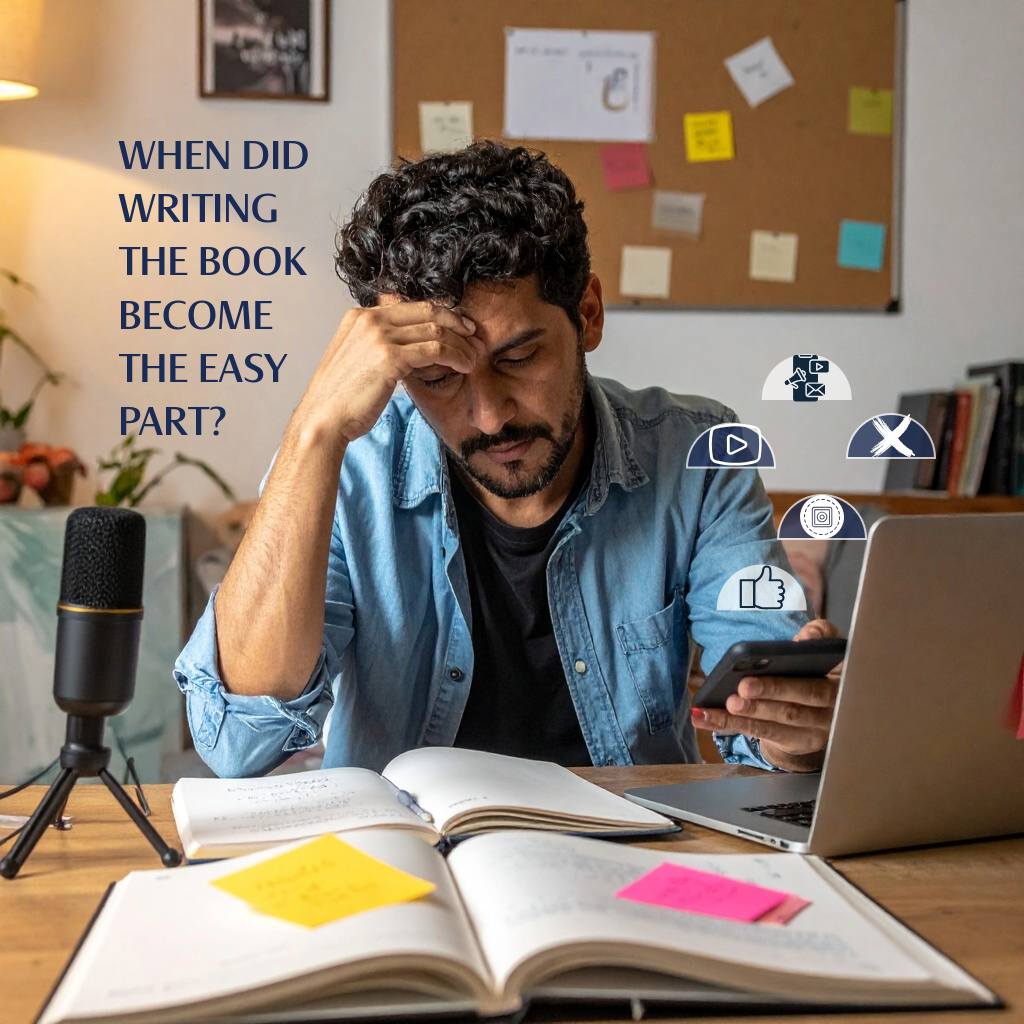
Author Business Automation: When did writing the book become the easy part?
At some point, something weird happens. You wanted to write books.
- Now you’re updating WordPress.
- Formatting an email.
- Trying to remember whether you scheduled tomorrow’s Instagram post.
- Uploading an audiobook file.
- Looking at analytics you barely understand.
- Fixing something that broke on your website.
- And somewhere underneath all of that is the book you’re supposed to be writing.
When did writing the book become the easy part?
I think a lot of independent authors eventually run into this.
In the beginning, doing everything yourself makes sense.
You probably have more time than money. You learn Canva. You figure out WordPress. You upload your own files. You post your own content. You answer every email.
Honestly, there’s something satisfying about it.
You built this thing.
But eventually there is a point where being able to do everything becomes the reason you’re not doing the thing that matters most.
And that’s where automation starts making sense.
Not because you need some giant AI system running your life.
Because maybe you just shouldn’t have to click the same button 47 times.
The Short Answer
Automate the things that happen repeatedly and predictably. Keep yourself involved in the things that require your judgment, creativity, or relationship with the reader.
That’s it.
You don’t need to automate your entire author business.
You need to stop spending your creative energy on things a system can reliably do for you.
What Are You Actually Spending Your Time On?
Here’s something worth trying.
Look at what you did for your author business last week.
Not what you planned to do.
What you actually did.
How much time did you spend writing?
Now compare that to:
- Copying information between systems.
- Checking whether something went out.
- Responding to routine questions.
- Fixing the same little problems you’ve fixed before.
That’s where things get interesting.
Because every one of those tasks might be legitimate.
But legitimate doesn’t mean you have to do it.
That’s Opportunity Cost
You have probably heard the term before.
Opportunity cost simply means that choosing one thing costs you the opportunity to do something else.
If you spend three hours fighting with an email template, those three hours came from somewhere.
Maybe they came from your next chapter.
Maybe they came from your family.
Maybe they came from sleep.
Maybe they came from sitting outside doing absolutely nothing—which, by the way, you’re allowed to do. 😄
The question isn’t:
“Can I do this myself?”
You probably can.
The better question is:
“Should I still be the person doing this?”
That is a very different question.
But I Don’t Want a Machine Running My Creative Work
Neither do I.
This is where I think automation gets confused with surrendering control.
They’re not the same thing.
You should absolutely make the decisions that shape your work.
Your voice matters.
Your characters matter.
Your ideas matter.
Your relationship with your readers matters.
Your judgment matters.
But whether an email gets sent at 9:00 Tuesday morning?
Probably doesn’t require your soul. 😂
Whether someone who buys your audiobook receives access to it?
That should happen without you sitting at your desk waiting for the order.
Whether a post that you’ve already approved gets published at the scheduled time?
Again—probably not the highest use of your creative brain.
The system should execute your decisions. It shouldn’t make you disappear from them.
That’s an important distinction.
What Should You Automate First?
Don’t start by asking:
“How much of my business can I automate?”
Start with:
“What do I keep doing over and over again?”
- Maybe it’s welcoming new subscribers.
- Maybe it’s delivering a free chapter.
- Maybe it’s giving someone access to a digital book after they purchase it.
- Maybe it’s scheduling posts you’ve already reviewed.
- Maybe it’s keeping track of a repeatable publishing workflow.
Automation works best when the task is repetitive, predictable, and does not require creative judgment.
Start there.
One annoying repetitive task.
Then another.
You don’t need to build some giant technology ecosystem overnight.
And trust me, I’m the technology guy saying that. 😄
Sometimes the right solution is automation.
Sometimes it’s better software.
Sometimes it’s hiring somebody.
Sometimes the answer is simply:
Stop doing that thing.
That’s an option too.
What Should You Keep?
Keep the parts where you matter.
- Your storytelling.
- Your decisions.
- Your conversations with readers.
- Your creative direction.
- The things only you can say.
- The things where someone needs you, not merely the result of a process.
That’s actually the reason I care about automation.
Not because I want machines doing everything.
I want machines doing enough of the repeatable stuff that people have more time to do the human stuff.
That’s very different.
Maybe That’s the Better Question
So maybe the question isn’t:
“When should I automate my author business?”
Maybe it’s:
“What am I still doing manually that doesn’t actually need me?”
Look at your week.
Find one thing.
Just one.
If you could make that task disappear without losing your voice, judgment, or control, would you?
Start there.
Because you became an author to create something.
You shouldn’t have to become a full-time systems administrator just to share it with the world.
If you’re trying to figure out which parts of your author business are worth systematizing, start with How to Build Your Own Author Marketing System.
Author marketing automation can also help with repetitive promotional tasks.
For example, you might schedule approved social posts, automate a welcome email sequence, or deliver a free chapter without manually sending it every time.
That does not mean putting your marketing on autopilot.
It means letting systems handle the predictable execution after you have already made the creative decision.
When Author Business Automation Starts to Matter
You do not need to automate everything.
You only need to notice when repeatable work is starting to crowd out the work that actually matters.
A thoughtful author business automation strategy can help you manage recurring tasks, maintain consistency, and reduce the amount of time you spend on administrative work.
The right author workflow automation should support your writing career without taking control away from you.
And good author marketing automation should make it easier to stay connected with readers without turning your voice into something generic or mechanical.
Start small.
Find one task you keep doing manually that does not actually need your creative judgment.
Automate that first.
Then see what time comes back to you.
That is the real value of author business automation.

0 Comments