
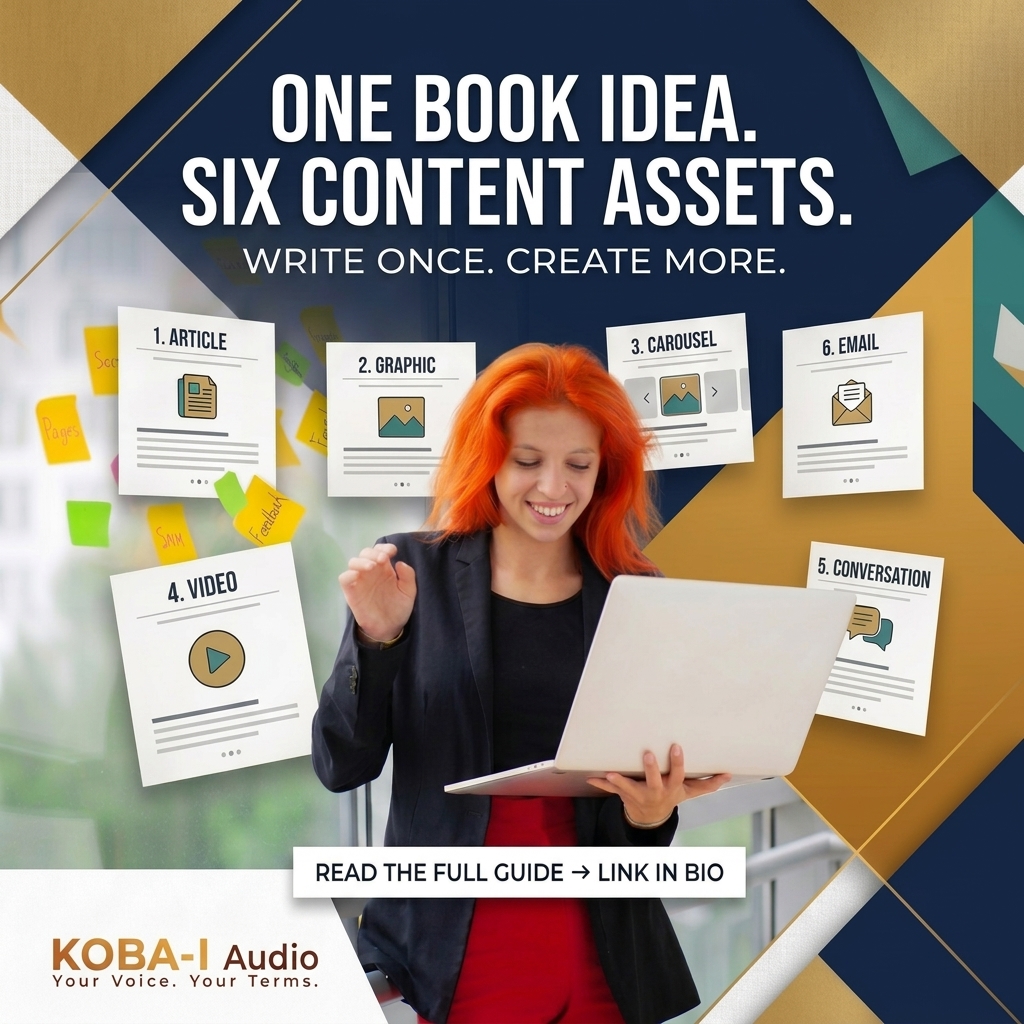
Content Repurposing for Authors: How One Book Idea Becomes Six Assets
The Short Answer
Content repurposing for authors is the practice of extracting one core concept from your manuscript and translating it into multiple formats—such as articles, graphics, carousels, short videos, conversation starters, and emails. Rather than blindly copying and pasting the same text everywhere, successful content repurposing for authors means adapting the idea to the native style of each platform. This modular approach allows authors to maintain consistent visibility and drive discovery without the ongoing workload of constantly generating new ideas from scratch.
The Workload of the Content Treadmill
Independent publishing requires consistency, but consistency is expensive. If you treat every social media platform, newsletter, and blog as a hungry machine that requires entirely original ideas every day, you will eventually burn out. The creative latency becomes too high. You end up spending more time managing your marketing than writing your next book. Instead, content repurposing for authors offers a sustainable solution.
The solution is not to work harder or post more often. The solution is better systems architecture. Instead of inventing new ideas for every platform, you need a blueprint for modular scale. You take a single, highly refined asset and adapt it across your ecosystem, focusing on content repurposing for authors.
How to Repurpose Book Content for Social Media (Without Spamming)
When authors ask how to repurpose book content for social media, they often make a critical error: they assume repurposing means repetition. They paste the exact same paragraph on Facebook, Instagram, and their blog, followed by a link to buy their book. This overlooks the potential of content repurposing for authors.
That is not adaptation; that is broadcasting. Your readers are intelligent. They ignore repetitive broadcasts.
True content repurposing for authors requires translating the idea into the native format of the channel. A visual platform requires a visual hook. A text-based network requires an engaging conversation starter. The core idea remains the same, but the execution changes. This is how you use the broader ecosystem to generate discovery while always routing interested readers back to your owned foundation.
The Blueprint: 1 Idea Into 6 Assets
Let us look at a practical mechanism for scaling a single concept. When I develop a narrative sequence for my own fiction project, Duncan the Man Hunter, I do not just write the chapter and move on. I extract the underlying mechanics—for example, the psychological toll of tracking a target or the specific surveillance technology Duncan employs. That single concept becomes a foundational blueprint in the context of content repurposing for authors.
Whether you write sci-fi thrillers, historical romance, or a non-fiction coaching framework, the system works the same way. Here is how one anchor idea becomes six distinct pieces of content through effective content repurposing for authors.
1. The Long-Form Article (The Foundation)
Start by writing a deep, useful article on your owned digital home base. For a nonfiction author, this might be a breakdown of your core coaching framework. For a fiction author, it could be an exploration of your world-building, character psychology, or the historical research behind your novel.
The Goal: Educate, establish authority, and capture search traffic through content repurposing for authors. This lives on your website, where you control the environment.
2. The Graphic (The Hook)
Pull one striking quote, statistic, or character truth from that long-form article. Place it over a high-quality, atmospheric background.
The Goal: Create immediate visual impact. You are not asking the reader to buy anything here. You are simply asking them to stop scrolling and feel something. In the caption, expand briefly on the quote.
3. The Carousel (The Sequence)
Break the core idea down into a logical sequence. If your anchor idea is “3 ways the magic system affects the economy,” create a 4-slide carousel. Slide 1 is the hook. Slides 2 and 3 deliver the information. Slide 4 invites them to learn more.
The Goal: Deliver practical value or immersive lore in a format designed for engagement and saving. Carousels reward readers who want to swipe and learn, emphasizing content repurposing for authors.
4. The Short Video (The Voice)
Take the exact same topic from your carousel, set up your camera, and speak directly to your audience for 45 seconds. Share your passion for the subject. Tell them why this specific detail matters to the story or to their own lives.
The Goal: Build a human connection. People connect with faces and voices. You are showing the architect behind the work through content repurposing for authors.
5. The Conversation Post (The Community Trigger)
Strip away all the media. Write a short, text-only post asking a targeted question related to your anchor idea. For example: “If you had to track a target across a hostile city, what is the one piece of gear you would refuse to leave behind?”
The Goal: Foster direct reader communication. Social platforms prioritize active conversations. Let your audience share their own perspectives, further enhancing content repurposing for authors.
6. The Email (The Direct Relationship)
Finally, adapt the concept for your newsletter. Share a behind-the-scenes look at why you wrote about this topic, link to the foundational article, and offer a natural next step—like downloading a free prequel chapter or checking out the full book.
The Goal: Deepen a durable, permission-based relationship. This is where discovery transitions into loyalty through effective content repurposing for authors.
Own the Foundation, Use the Ecosystem
External marketplaces and social networks are incredibly powerful distribution tools. They are part of a healthy author ecosystem. But distribution is not ownership, and dependency is risky.
When you use the ecosystem to generate discovery, your goal should always be to guide readers back to a digital home base that you control. At KOBA-I Audio, we build the infrastructure that makes this independence practical. We believe authors should own their customer relationships and their data.
It is crucial to understand the difference between a transaction and a relationship. A purchase on an external marketplace does not give you the customer record, nor does it constitute newsletter consent. Even on your own platform, a transactional record is different from permission-based marketing. You must earn the right to their inbox by offering consistent value.
When you build a direct sales infrastructure, the economics shift in your favor. For instance, KOBA-I takes no royalty from direct sales; ordinary payment processing, hosting, and operating costs may still apply, but the lion’s share of the revenue—and 100% of the customer relationship—remains yours.
Frequently Asked Questions
Does repurposing content hurt my search engine rankings?
No, as long as you are adapting the content for different platforms rather than publishing identical articles across multiple websites. Social media posts, videos, and graphics do not compete with your website’s SEO. They amplify it, leveraging content repurposing for authors.
How much time should I spend repurposing compared to writing my book?
Your primary job is writing the book. The technology and marketing are never the hero; the author is. By using a modular system, you can batch your content creation into a few hours a week, leaving the vast majority of your time protected for deep creative work focused on content repurposing for authors.
Can I use AI to help repurpose my content?
Yes. AI tools are simply instruments in your ecosystem. You can use them to extract quotes, summarize your foundational article into a carousel script, or format your ideas. However, the original thought, voice, and creative direction must remain yours, especially in the realm of content repurposing for authors.
Next Steps
You do not need to invent thirty new ideas this month. You only need five strong concepts, properly scaled.
If you are ready to strengthen direct reader relationships and start building a durable, scalable business around your creative work, you need a blueprint for content repurposing for authors. Download The Independent Author’s Playbook today to learn how to architect a digital home base that puts you in control of your intellectual property, your audience, and your future.
In this series: Start with the sustainable content marketing framework, use this execution method, then build the 30-day implementation plan.

0 Comments